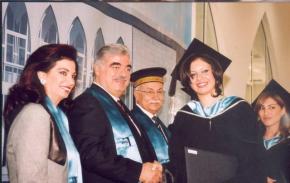
Rafik Hariri philanthropic and developmental contributions are countless. The most remarkable being the multifaceted support to educate more than 36,000 Lebanese university students within Lebanon, and beyond.
You are here
THORADIC DYNAMICS IN SIMULATED FRONTAL IMPACT
Primary tabs
Ali M. HAGEDIAB
|
Univ. |
Marquette |
Spec. |
Biomedical Engineering |
Deg. |
Year |
Pages |
|
Ph.D. |
1995 |
181 |
Attempts to quantify the biofidelity of the Hybrid III thorax have employed indirect methods, which do not fully replicate seat belt‑chest loading. The few experimental studies mimicking real life crashes have used chest deflections as an evaluation criteria. Little attention has been given to the force distributions over the chest and the shoulder complex.
In this study, experiments originally designed to quantify chest deflections of human cadavers and manikins are used in an analytical scheme to predict force distributions over the chest and shoulder. In these experiments, cadavers and the 50th percentile Hybrid III manikin were used in deceleration sled tests to simulate a frontal crash. Six cadaver tests and two Hybrid III test were conducted at high velocity impact (ΔV=13.4m/s), and three cadaver tests at low velocity impact (ΔV=6.7m/s). Surrogates were instrumented with two chestbands to provide chest contours. A three‑point belt instrumented with a force transducer above the shoulder level was used for restraining the surrogates. Onboard and offboard high‑speed cameras captured the left and frontal‑left views of the occupant. The two cameras were synchronized by a flashlight and/or film event marker.
The captured crash views were used to reconstruct the motion of the surrogates in three dimensions. This information was used in conjunction with the contour records from the chestbands to reconstruct the shape of the shoulder belt at five levels; the upper anchorage point, shoulder, upper chestband, lower chestband, and the lower anchorage point. Shoulder belt tension records were used with the belt shape in vector analysis to determine the forces at the three belt levels, which are in contact with the occupant. Student T‑test was used to establish statistical significance.
Kinematic results showed that the vertical range of motion of the head and thorax in the Hybrid III manikin are more than those in the cadavers at high speed (p<0.04). Also, human cadaver studies showed that the frontal range of motion of the head and thorax are more in high-speed tests (p<0.02). In high velocity tests, the shoulder and the lower thorax of the Hybrid III manikin sustained lower forces compared to human cadavers ([0.94 kN/3.93kN=24%; p=0.22] and [2.l4kN/3.45kN=62%; p=0.581], respectively). In contrast, the upper thorax sustained higher forces (7.86kN/5.42kN=l45%; p=0.005).