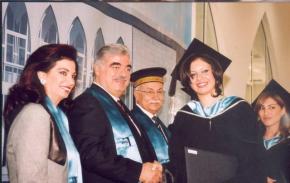
Rafik Hariri philanthropic and developmental contributions are countless. The most remarkable being the multifaceted support to educate more than 36,000 Lebanese university students within Lebanon, and beyond.
You are here
TEMPORAL RELATIONSHIPS BETWEEN FOOT PRESSURE AND MUSCLE ACTIVITY DURING WALKING
Primary tabs
Rami J. ABBOUD
|
Univ. |
Dundee |
Spec. |
Biomedical Engineering |
Deg. |
Year |
Pages |
|
Ph.D. |
1995 |
291 |
A six channel portable electromyographic measurement (EMG) system has been designed and synchronized, using a specially developed external trigger linking two IBM personal computers together, with a sixteen channel piezoelectric inshoe foot pressure measurement system called GaitScan. The resulting system provides six channels of EMG and sixteen channels of foot pressure, eight per individual insole.
This system was used to study relationships between the activity of five muscle of the lower limb (Gastrocnemius, Soleus, Anterior tibialis, Peroneus Longus and Peroneus Brevis) and foot pressure underneath the eight loading points of the plantar surface of the foot (heel, lateral arch, the five metatarsal heads and the hallux). Barefoot contact pressures have also been assessed, using a Dynamic pedobarograph (DPBG), for comparison with the inshoe measurements. Surface Silver/Silver Chloride (Ag/AgCl) electrodes have been used. They were implemented in a careful and repeatable method to secure low skin‑impedance and with extra care in order not to break the skin during abrasion. Normal subjects have been assessed and considered to be the control group with whom diabetics, with and without neuropathy, were compared.
Twenty-two 'normal' controls and twenty-nine 'diabetic' subjects have been studied. Inshoe pressure measurements were found to be higher than barefoot pressure measurements, especially underneath all of the metatarsal heads (first (p<0.05), second, third (p<0.001), fourth (p<0.001) and fifth (p<0.03). In diabetics, the period of peak contact pressure was greater than in normal, both in inshoe and barefoot (p<0.003 and p<0.001 respectively). The initial forefoot time contact was shorter in diabetics when compared to controls, indicating a faster forefoot contact. In the dorsiflexor muscle, Anterior tibialis, normally contracting eccentrically at heel strike, there was a measurable delay in contraction (p<0.001) in diabetic subjects when compared to normal control. The results obtained may assist the surgeon, the orthotist and the bioengineer in at least three ways: to show selective neuromuscular activity and help in the selection of available treatment modalities, to aid in‑ planning realignment procedures of the foot and to prevent development of ulcers on the sole of the foot which may eventually lead to unavoidable amputation.