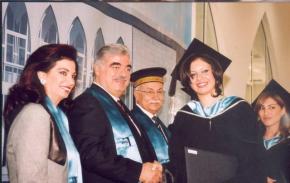
Rafik Hariri philanthropic and developmental contributions are countless. The most remarkable being the multifaceted support to educate more than 36,000 Lebanese university students within Lebanon, and beyond.
You are here
AN INVESTIGATION INTO LIQUID FILM ABSORBERS FOR REFRIGERATION SYSTEMS
Primary tabs
Ghaleb A. IBRAHIM
|
Univ. |
London |
Spec. |
Mechanical Engineering |
Deg. |
Year |
#Pages |
|
Ph.D. |
1991 |
274 |
This thesis presents a theoretical analysis of falling liquid film absorbers with three modes of cooling (cross‑ parallel‑ and counter flow); together with an attempt to provide experimental verification.
By way of introduction vapor absorption system (VAS) is compared to vapor compression system (VCS) and absorber types are discussed.
A review of the previous works are given, which is followed by the theoretical analysis of falling film absorbers based on the energy and diffusion equations in a fully hydrodynamically developed laminar flow. Both equations are coupled at the vapor ‑ liquid interface and are solved by a hybrid technique which combines an analytical solution in the entry region and at the vapor‑liquid interface with a numerical technique (finite differenceCrank‑ Nickleson scheme).
The finite difference can also be applied instead of the hybrid technique and for that a maximum mesh size has been suggested. However it was found that for a very small Lewis number, it requires long computing time.
Two simple absorber design techniques have been suggested. One is based on the heat and mass transfers coefficients and the other on the heat and mass effectiveness.
The Sherwood number and the mass effectiveness have been correlated.
An experimental apparatus has been built to investigate the concentration variation in a flat plate absorber. The refrigerant /absorbent pair used was a LiBr/H20 solution. The mixture flow rate was measured by noting the hydrostatic head over an orifice and a conductivity meter with two cells has been used to measure the concentration. Some experimental results have been obtained and‑compared with the theoretical model.
The theoretical results have been analyzed, discussed, and compared with previous available theoretical and experimental data.
For future work, three theoretical models have been suggested.