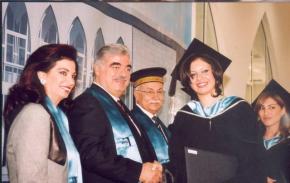
Rafik Hariri philanthropic and developmental contributions are countless. The most remarkable being the multifaceted support to educate more than 36,000 Lebanese university students within Lebanon, and beyond.
You are here
THE PERFORMANCE AND CHARACTERISTICS OF A VORTEX AMPLIFIER IN TWO-PHASE GAZ/LIQUID FLOWS
Primary tabs
Abdul Majid S. ABDUL GHANI
|
Univ. |
Liverpool |
Spec. |
Mechanical Engineering |
Deg. |
Year |
#Pages |
|
Ph.D. |
1991 |
200 |
Fluidic vortex valves have an inherent reliability due to their having no moving parts, and because of this they have found a number of applications as flow control elements in the demanding environment of the nuclear reprocessing industry. To exploit further the characteristics of fluidic valves, and to expose other industries to the technology, research is being carried out into other applications. One such program is the development of a fluidic oil well choke valve for controlling two-phase gas/liquid flow. The vortex amplifier obtains its flow control capability from the radial pressure gradient generated by a confined vortex within the device. Whilst the use of a vortex amplifier appears attractive for controlling violent two-phase flows, there was concern that the gas and liquid phases would separate in the centrifugal pressure field and that the device would be ineffective. A two-phase flow facility has been built and an axial vortex amplifier, designed to suit a 75mm pipe has been manufactured and tested.
The results show that the vortex amplifier does operate with two-phase flow and within cavitating flow but that the turndown ratio reduces. The reason for this has been shown to be the significant reduction in pure supply flow through the device as it resistance in two-phase and cavitating flow increases. This is due mainly to shocking and to poor diffuser efficiency. A two-phase correction factor to link the single-phase and two-phase flow characteristics has been proposed but it is recognized that this may be modified by subsequent the investigation.
A description of a separate study into diffuser efficiency in two-phase flow is also reported in this thesis. The pressure recovery from a homogenized two-phase flow in a conical diffuser was measured. The flow was an air/water mixture with volumetric void fractions up to 35%. Although the pressure recovery was reduced because of the two-phase flow, the use of the diffuser is still beneficial. For example, whereas a 70 diffuser in single-phase flow achieves a pressure recovery of about 85%, the same diffuser operating in 20% void fraction has a pressure recovery of about 70%; this compares with about 20% through a sudden expansion. It has been found that the optimum angle of the diffuser in two-phase flow is the same as in single-phase flow,i.e. 70. An expression proposed for predicting the pressure recovery coefficient of a diffuser operating in two-phase flow.
In the oil industry, the knowledge of the pressure and the flow rate at the wellhead is essential in designing the choke valve. A detailed method for predicting the flow rates at the wellhead and designing the vortex amplifier, starting from the production rig was developed. It was found that it is possible to predict the flow rates at the wellhead using mechanistic techniques from which it is possible to design a vortex amplifier to operate as a choke valve for the oil well.