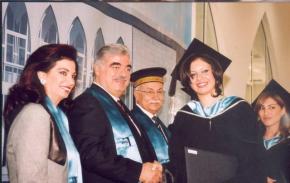
Rafik Hariri philanthropic and developmental contributions are countless. The most remarkable being the multifaceted support to educate more than 36,000 Lebanese university students within Lebanon, and beyond.
You are here
LASER-CONTROLLED RAPID PROTOTYPING OF PHOTONIC INTEGRATED CIRCUITS
Primary tabs
Louay A. DADA
|
Univ. |
Columbia |
Spec. |
Electrical Engineering |
Deg. |
Year |
#Pages |
|
Ph.D. |
1994 |
218 |
Photonic integrated circuits offer important cost and environmental advantages over circuits composed of discrete components. However, the design and fabrication of complex, large‑area photonic integrated circuits (PICs) is severely limited by the lack of prototyping tools as well as the appropriate device structures. This thesis describes the use of a novel laser fabrication process for the rapid prototyping of integrated optical circuits in compound semiconductor substrates. The fabrication is based on a type of laser direct photoelectrochemical etching process that uses a focused laser beam which is scanned under computer control to form micrometer‑scale grooves, thereby patterning rib‑like optical waveguide structures. In the first part of this thesis, the technique of micrometer‑scale photoelectrochemical etching of GaAs is described. A brief discussion of the chemistry involved in this process is first presented as background information, then a description of the apparatus used is presented, and the factors controlling the etch rate and etch feature resolution are considered.
The use of this technique for the fabrication of several passive integrated optical devices in GaAs is then presented. These "building block" devices include linear waveguides, bends, Y‑branches, and tapers. From these, we were able to form simple passive devices such as splitters and directional couplers. These devices have low optical loss, are single‑mode, and can be accurately modeled using effective index calculations.
The usefulness of this technique as a prototyping tool is then demonstrated by its use in the fabrication of the first sub‑Angstrom integrated channel‑dropping filter. Because the fabrication technique is maskless and is locally controllable in real time, it can be used to fabricate novel device structures.
After the presentation of the passive devices results, the use of this technique to fabricate several active devices is discussed. The etching for these devices was done by the direct process described above. The optical performance of these devices was characterized as well and they were found to exhibit unusually low voltage‑length products with excellent performance characteristics.
Finally, after the demonstration of the successful fabrication and testing of most major passive and active waveguiding devices, we discuss the fabrication of simple photonic integrated circuits. One such circuit is an optical delay line, which uses true‑time‑delay for steering microwave phased array radar. Using beam, propagation simulation capabilities that we developed in our labs, we easily studied various designs for such circuits, and then using our laser prototyping technology, we easily implemented various structures. Other photonic integrated circuits whose implementation is considered include switching arrays and wavelength demultiplexers.