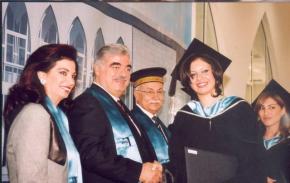
Rafik Hariri philanthropic and developmental contributions are countless. The most remarkable being the multifaceted support to educate more than 36,000 Lebanese university students within Lebanon, and beyond.
You are here
Impact Response of Prestressed Concrete Beams
Primary tabs
Abdel nasser A. KHAWANDI
|
Univ. |
Sheffield |
Spec. |
Civil and Structural Engineering |
Deg./Ph.D. |
Year 1990 |
# Pages/190 |
The experimental and theoretical aspects of the beam impact problem were investigated. As an impact loading one may understand either an impact by an aircraft, ship, or car against a structure.
The experimental part of the research investigates the behavior of a simply supported I-section pre-tensioned prestressed concrete beam model under a hard type impact. The impact was generated by a free falling hammer on the beam mid-span. The main parameters investigated were the prestressing force level in the beams and the velocity of the impact.
The force-time history was recorded at two strain gauge stations positioned along a pressure bar which served to transmit the impact into the beam. Deflections at different positions along the beam span were also recorded and high speed photography was employed.
Static and post impact static tests were carried out to assess the residual strength and residual stiffness of the beam after impact.
The tested beams exhibited a strong resistance and a high deflection recovery whenever they survived the impact. However, brittle and sudden collapse was observed under severe impacts calling for the necessity of special measures to be taken which may allow this type of structure to safely deform in a more ductile manner.
A single degree of freedom model was developed to predict the flexural response of the impacted beams. The model is based on step-by-step numerical integration and a proposed bilinear resistance function of the beam. The theoretical results showed a close agreement with the measured ones.
The dynamic characteristics of the beams were determined experimentally and the damping coefficient was subsequently incorporated in the proposed theoretical model.
The early phase of the measured force-time history was interpreted in terms of stress wave analysis. Energy and momentum approaches were also considered.
The theoretical and experimental results were discussed.