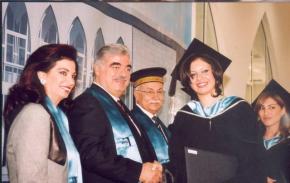
Rafik Hariri philanthropic and developmental contributions are countless. The most remarkable being the multifaceted support to educate more than 36,000 Lebanese university students within Lebanon, and beyond.
You are here
AN ANALYSIS OF TEACHING PRACTICES WITHIN THE HARIRI SPECIAL ENGLISH PROGRAM IN THE REPUBLIC OF LEBANON
Primary tabs
Ghazi M. GHAITH
|
Univ. |
Indiana |
Spec. |
Education |
Deg. |
Year |
#Pages |
|
Ed.D. |
1991 |
186 |
This study has described and analyzed the teaching practices within the Hariri Special English Program in the Republic of Lebanon. The study included a review of the original plan according to which the Hariri Program was supposed to be implemented and a delineation of its current implementation. In addition, the study compared the original plan, current implementation, and contemporary second language recommendations for teaching writing, reading, oral fluency, and listening comprehension.
The study's main purpose was to examine the teaching practices according to which considerable numbers of Lebanon's high school graduates and professionals were being prepared to function in all‑English curricula at the university level.
Data collection involved a review of second language theories and research to synthesize contemporary recommendations for linking theory to classroom practice. In addition, four data sources were used to study the Hariri Program. These sources included documents, archival records, direct observation, and interviews.
Data analysis was partly simultaneous with data collection and included three basic phases : 1) analysis during data collection, 2) unitizing data and devising categories, and 3) writing the final report.
The results of the study indicate that current implementation of the program is more congruent with contemporary second language thinking than its original plan. This was primarily due to an in‑service staff training continued to the present.