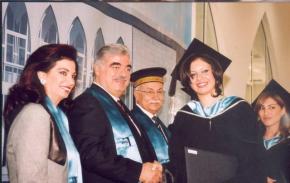
Rafik Hariri philanthropic and developmental contributions are countless. The most remarkable being the multifaceted support to educate more than 36,000 Lebanese university students within Lebanon, and beyond.
You are here
THE IMPACT OF WAR ON THE LEBANESE ADMINISTRATION A STUDY IN ADMINISTRATIVE DISRUPTION
Primary tabs
Randa D. ANTOUN
|
Univ. |
York |
Spec. |
Political Science |
Deg. |
Year |
#Pages |
|
Ph.D. |
1988 |
250 |
The present work is a study of administrative disruption arising out of the civil war in Lebanon. It provides a framework for the investigation of the concept of administrative disruption, which is understood as the effects upon a given bureaucratic system of massive and sudden changes in its environment, such as those occasioned by natural disasters, or by war.
A "given bureaucratic system" is understood as the Weberian ideal‑type, modified first by the political system or historical/constitutional variable, and second by the social system or societal values variable.
A review of the literatures on disasters and wars produces a categorization of administrative disruption into three types: operational disruption, structural disruption, and disruption of norms.
War is thus treated as an exogenous variable, which has impacts upon an administrative system whose responses are limited by endogenous variables. In the empirical case, the history of Lebanon, its consociational democracy regime and its profoundly sectarian and 'familist' social characteristics are, therefore all actors in the current situation, as well as the war.
Public administration in Lebanon is examined to determine what observable changes in practice and conduct can be ascribed to the war. Certain observations (in particular, the existence of "alternative administrations" in some areas) are not predicted by the model, and the general collapse of Lebanese administration, the thesis concludes, is ascribable more to the endogenous variable than to the exogenous.