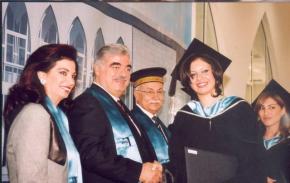
Rafik Hariri philanthropic and developmental contributions are countless. The most remarkable being the multifaceted support to educate more than 36,000 Lebanese university students within Lebanon, and beyond.
You are here
THE LEGAL FRAMEWORK OF THE EXTERNAL RELATIONS OF THE EUROPEAN ECONOMIC COMMUNITY AND THE EUROPEAN COAL AND STEEL COMMUNITY WITH LEBANON
Primary tabs
Abdul Hassan H. HAIDAR
|
Univ. |
Glasgow |
Spec. |
Law/Financial Studies |
Deg. |
Year |
#Pages |
|
Ph.D. |
1991 |
354 |
The present thesis, "The legal framework of the external relations of the European Economic Community and the European Coal and Steel Community with Lebanon", examines the legal aspects of the external relations of these two Communities with respect to Lebanon, with special reference to their common commercial policy and development policy. In examining twenty five years of relationship between the two parties, the thesis endeavors to answer whether Lebanon, at any time, received special treatment from the EEC corresponding to the historical, political, economic, cultural and geographical close ties between them as reflected in the legal rules which provides the framework for the EEC-Lebanese trade and commercial relations. The thesis, moreover, evaluates the developments in the legal framework of these relations in the light of the developments in international trade rules and whether the European Communities' agreements with Lebanon responded to Lebanon's special characteristics and level of development and consequently responded to its special needs. Furthermore, the thesis assesses the contribution of the contractual relationship of the relevant parties to the development of their trade relations, with particular emphasis on Lebanon's exports to the EEC markets.
The relationship between Lebanon and the European Communities passed through three stages in its form of development, from non-preferential trade arrangements to reciprocal partial preferential trade arrangements and thereafter to non-reciprocal preferential trade arrangements.
Experience shows that where the right terms and suitable conditions were given, relations between the EEC and a less developed country can be fruitful. However, although Lebanon received preferential treatment within the EEC Mediterranean policy, this preferential treatment proved to be fruitless. The European Economic Community moved half-heartedly in developing the legal framework of its relations with Lebanon, thereby offering preferences to Lebanon on the one hand and making inroads into them on the other.
Following the adoption of preferential treatment within their trade legal system, Lebanon's exports to the EEC fell. In addition, the EEC development aid to Lebanon represents "a drop in the Ocean".
The justified conclusion is that any future equilibrium in trade relations between both parties is not expected. Is it not now the time for attempting to develop a legal framework for integrating the natural regional markets of Lebanon?