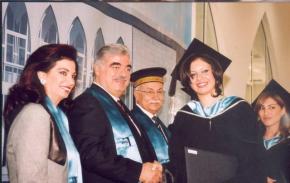
Rafik Hariri philanthropic and developmental contributions are countless. The most remarkable being the multifaceted support to educate more than 36,000 Lebanese university students within Lebanon, and beyond.
You are here
SINGULARLY PERTURBED OPTIMAL CONTROL PROBLEMS WITH TIME - DELAY
Primary tabs
Bassem B. GHALAYINI
|
Univ. |
University of California Los Angeles |
Spec. |
Mathematics |
Deg. |
Year |
# Pages |
|
Ph.D. |
1995 |
92 |
A study is made of a class of boundary value problems for linear second order differential difference equations in which the highest order derivative is multiplied by a small parameter. Consideration of the exact solution of simple model equations provides insight into the appropriate use of singular perturbation technique for more general problems. The resulting analysis leads to several novel features which are not present in problems without differences.
We see how a time-delay can affect the structure of the solution by introducing interior or transient layers, a phenomenon that does not occur in the no-delay case. This is due to the existence of terms like x(t ± t) where i is the time-delay and due to the continuity of the solution.
The applicability and the computational simplicity of the asymptotic method on several examples clearly shows that it is quite possible that the method developed can be applied to some physical and social systems of complex nature.
As an application we derive necessary conditions for the local optimality of certain functionals subject to differential constraints with constant and variable time-delay. In general, these necessary conditions turn out to be systems of differential equations consisting of both advanced and retarded type.
In general, a high-order system may exhibit simultaneously both fast and slow dynamics. This type of system is stiff and presents numerous computational difficulties even when the order of the system is not high. To reduce the computational burden, one might neglect some small parameters like coupling parameters, time-delays, masses, capacitances etc., in the system equations. However, a design based on this reduced low-order ordinary model may not give satisfactory performance when applied to a high-order model as it cannot, in general, take into account all the boundary conditions of the high-order model. This thesis explains how we use asymptotic series methods which will reintroduce the neglected parameters and the boundary conditions. One example illustrates the constructional and computational simplicity of the method developed.
By providing practical and simple analytical tools we hope to encourage the use of difference differential equations to model physical and biological problems in optimal control theory as well as in other areas that involve singular perturbations with time-delay, e.g., population dynamics, and chemical engineering.