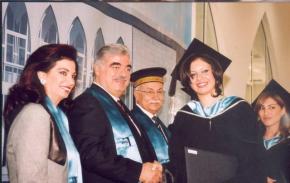
Rafik Hariri philanthropic and developmental contributions are countless. The most remarkable being the multifaceted support to educate more than 36,000 Lebanese university students within Lebanon, and beyond.
You are here
MODELING GAS AND HEAT GENERATION AND TRANSPORT IN SANITARY LANDFILLS
Primary tabs
Mouhtassem A.T. El- FADEL
|
Univ. |
Stanford University |
Spec. |
Civil Engineering/ Environmental |
Deg. |
Year |
# Pages |
|
Ph.D. |
1991 |
385 |
Early efforts to model methane production in landfills were based on a mathematical description of gas migration and simple empirical functions for the rate of methanogenesis (Findikakis and Leckie, 1979; Findikakis et al., 1988). A description of methanogenesis based on first principles governing the microbiological processes and biochemical reactions associated with methane and carbon dioxide generation in landfills was presented by Halvadakis (1983). Based on the concept of a solid substrate bio-reactor, Halvadakis developed a simplified system of equations describing the dynamics of the microbial landfill ecosystem, starting with the hydrolysis of the hydrolyzable and biogasifable refuse waste component, passing through the utilization of aqueous carbon, growth and decay of acidogenic and methanogenic biomass, and ending with the utilization of acetate and consequent generation of methane and carbon dioxide. However, Halvadakis and others did not consider the interactions between landfill temperature and methanogenesis. Internal landfill temperature is an important factor in landfill methanogenesis, first because temperature affects methanogenesis rates and second, because steep temperature gradients influence gas pressure gradients that play an important role in gas transport throughout the landfill mass. A temperature increase of a few degrees can cause an increase in the total pressure equal to or greater than the pressure increase due to methane and carbon dioxide generation from organic carbon biodegradation at constant temperature. Temperature variations affect the physical, chemical and biological components of the ecosystem as well. Several solutions of the heat transport equation in porous media are available in trying models which deal with simultaneous heat, mass, and momentum transfer in multiphase systems (Young 1969, Whitaker 1977, Spolek and Plumb 1982, Valchanova and Valchan 1982 ). However, no attempts to model the time and space variations of landfill temperature have been reported in the literature.
The overall objective of this research has been to develop a numerical model incorporating the basic concepts from microbiology, chemistry and physics to simulate the spatial and temporal production and transport of biogas and heat in sanitary landfills. This objective was accomplished in two major steps : first, the incorporation of Halvadakis's equations (Halvadakis, 1983) for the microbial landfill ecosystem dynamics in the multi-layer, time-dependent gas transport and production model (Findikakis and Leckie, 1979) and second, the development of a heat generation and transport model that when coupled with the gas generation and transport model, simulates the spatial and temporal temperature distribution within landfills, as well as the temperature effects and feedbacks on the chemical, biological and physical properties of the ecosystem. The final numerical model was used to simulate data collected over a period of four years at the Mountain View Controlled landfill Project. The model was also used to assess the sensitivity and significance of the physical, chemical, and biological parameters that control gas and heat generation and transport in sanitary landfills.